By 2025, Albania's internet infrastructure improved significantly, boosting fixed broadband speeds to a median of 82.28 Mbps (up from 76.06 Mbps the previous year). Fiber-to-the-home (FTTH) networks expanded in cities like Tirana and Durrës, offering gigabit speeds, while 5G services launched in November 2024, reaching 19% of users by early 2025. Rural areas benefited from Starlink's satellite internet, with speeds of 50–200 Mbps.
Key Highlights:
- Tirana: Fastest city with median download speeds of 86 Mbps; Digicom leads with 142.3 Mbps.
- Shkodër: Second-fastest at 84 Mbps, offering strong upload speeds of 43 Mbps.
- Vlorë: High upload speeds (46 Mbps) but slightly slower downloads at 78 Mbps.
- Durrës: Moderate speeds (56 Mbps download, 31 Mbps upload) but early 5G adoption.
Albania's National Broadband Plan aims for 1 Gbps connections in 50% of urban areas by 2025. These advancements make Albania an attractive option for remote workers, supported by 96.7% household internet access and growing 5G coverage.
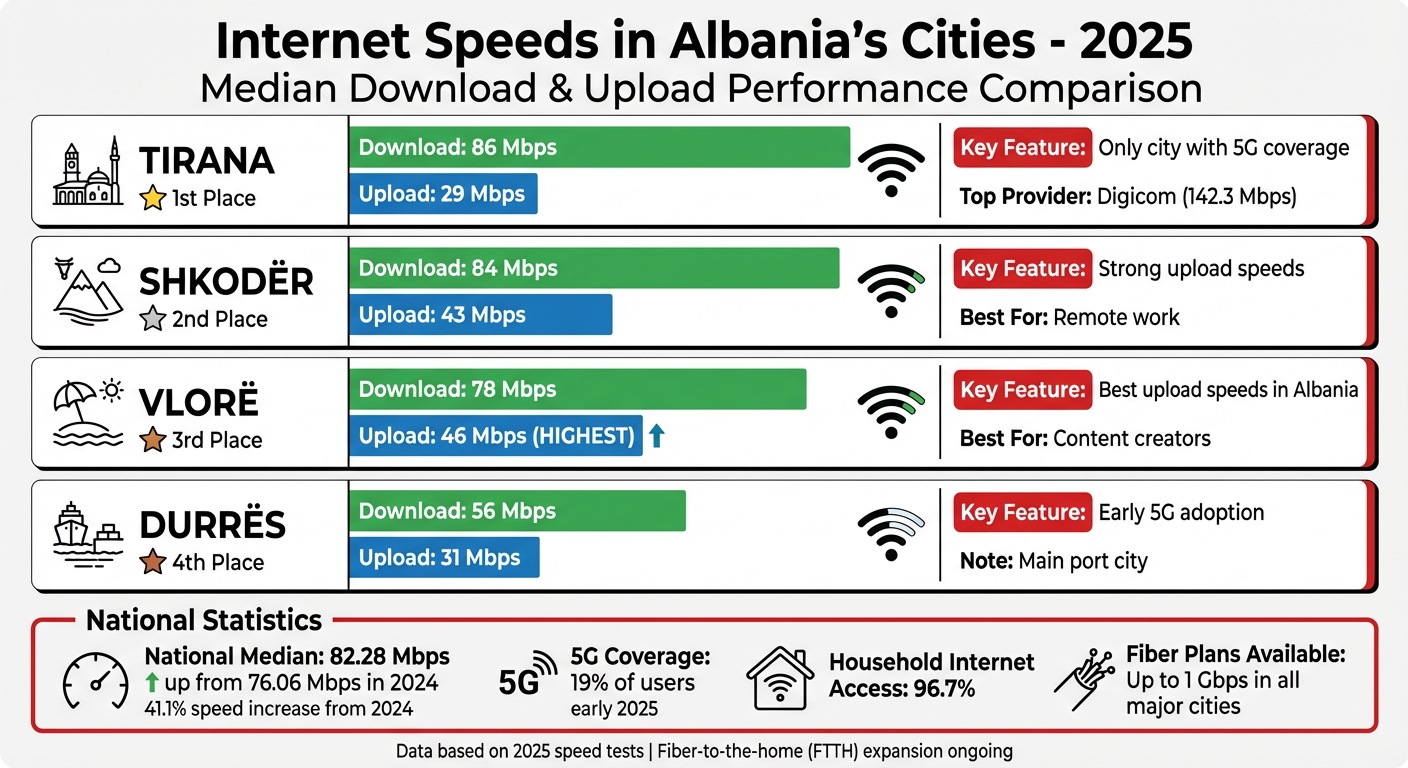
Albania Internet Speeds by City 2025: Download and Upload Speed Comparison
Staying Connected in Albania for Americans: Keep Your US Number + Local Services (2025)
1. Tirana
Tirana stands as Albania's digital powerhouse, hosting the country's only Internet Exchange Point (IXP) and accounting for half of Albania's fixed broadband connections. This infrastructure advantage ensures reliable internet connectivity, making the city an appealing destination for remote workers and businesses. Its solid network foundation supports impressive median speeds and competitive gigabit-level plans.
Median Download Speeds
Tirana offers a median download speed of 86 Mbps, with speeds projected to range between 75–96 Mbps in 2025. Among the providers, Digicom leads with an impressive average download speed of 142.3 Mbps during the 12 months ending March 2025. Following Digicom are Vodafone at 65.43 Mbps and One Albania at 36.37 Mbps.
Median Upload Speeds
The city's median upload speed averages 29 Mbps, varying between 24 Mbps and 31 Mbps based on location and provider. However, this figure lags behind other cities like Vlorë (46 Mbps) and Shkodër (43 Mbps). Digicom users enjoy superior upload speeds, with averages reaching 41.5 Mbps.
Top Advertised Speeds
Major providers in Tirana advertise speeds of up to 1 Gbps, but Digicom takes it a step further with 2.5 Gbps XGSPON plans. These ultra-fast plans require advanced equipment, including WiFi 6/7 routers and CAT6 cabling. Standard fixed broadband packages, offering speeds between 20–50 Mbps, cost between 1,500 and 2,000 ALL per month (around €14–€19). Meanwhile, premium fibre plans with 100 Mbps speeds are priced at €25–€30 monthly.
5G Network Availability
Tirana is currently the only city in Albania with commercial 5G coverage, delivering average download speeds of 100–110 Mbps. By early 2025, roughly 19% of users and devices nationwide had access to 5G signals. One Albania operates its 5G services on the 3.4–3.5 GHz spectrum band, while the network infrastructure avoids Huawei and ZTE equipment due to Albania's involvement in the U.S. "Clean Network" initiative.
2. Durrës
Durrës holds a key position as Albania's main port city, just a short distance from Tirana. This strategic location has enabled the development of a solid internet infrastructure, which benefits both locals and the increasing number of digital nomads drawn to its coastal charm. Notably, Durrës was among the first cities in Albania to experience commercial 5G services, launched on 25 November 2024. While fiber-optic networks are expanding, actual speeds remain moderate. Let’s dive into how Durrës performs in terms of connectivity.
Median Download Speeds
In late 2025, Durrës recorded an average download speed of 56 Mbps based on 5,441 tests. While this is lower than Tirana (86 Mbps), Shkodër (84 Mbps), and Vlorë (78 Mbps), the city maintains a consistent range of 47–60 Mbps. These speeds, though not the fastest, are stable enough to support remote work, video streaming, and other common online activities.
Median Upload Speeds
When it comes to uploads, Durrës averages 31 Mbps, with speeds varying between 24 Mbps and 34 Mbps depending on the provider and location. Interestingly, this figure surpasses Tirana's average of 29 Mbps. Such steady upload speeds are a plus for residents and visitors who rely on reliable connectivity for tasks like video conferencing and file sharing.
Top Advertised Speeds
Fiber-optic providers in Durrës advertise speeds of up to 1 Gbps, aligning with Albania's National Broadband Plan, which aims for 50% of urban connections to achieve gigabit speeds by the end of 2025. Standard broadband packages offering 20–50 Mbps are priced between 1,500–2,000 ALL/month, while premium 100 Mbps fiber plans cost around €25–€30/month. For areas without fiber coverage, Starlink provides an alternative with speeds ranging from 50–200 Mbps at a monthly cost of 6,500 ALL, plus a one-time hardware fee of 42,500 ALL.
5G Network Availability
Durrës has embraced 5G technology quickly, with about 19% of users nationwide accessing 5G by early 2025. Peak 5G download speeds have exceeded 500 Mbps in test environments, although 4G LTE remains the dominant network, covering 96% of users. Notably, the 5G rollout in Durrës avoids equipment from Huawei and ZTE, instead opting for European suppliers like Ericsson. This approach aligns with Albania's participation in the U.S. "Clean Network" initiative.
3. Vlorë
Vlorë secures its spot as the third-fastest city in Albania for internet speeds. As a bustling coastal destination, it caters to both residents and tourists with dependable digital connectivity. A major upgrade in 2025 significantly improved its infrastructure, reflecting Albania's broader efforts to enhance internet access across key cities.
Median Download Speeds
Vlorë keeps pace with other leading cities in Albania when it comes to download speeds. In 2025, 78 Mbps was the average download speed recorded from 2,519 tests. While this figure trails behind Tirana's 86 Mbps and Shkodër's 84 Mbps, it easily outpaces smaller cities like Sarandë (47 Mbps) and Gjirokastër (32 Mbps). These numbers highlight a national trend of rising fixed internet speeds, which grew by 41.1% in the year leading up to January 2025.
Median Upload Speeds
When it comes to upload speeds, Vlorë takes the lead with an average of 46 Mbps, ranging between 34–56 Mbps. This performance surpasses Tirana's 29 Mbps and Shkodër's 43 Mbps, making it a top choice for remote workers who rely on fast uploads for tasks like file sharing and video conferencing. This improvement reflects a broader national increase in upload speeds, which grew by over 30% from 2024 to 2025.
Top Advertised Speeds
Fiber-optic providers in Vlorë offer plans with speeds reaching up to 1 Gbps, on par with other major cities in Albania. Standard broadband packages with speeds of 20–50 Mbps cost between 1,500–2,000 ALL per month, while premium fiber plans offering 100 Mbps are available for €25–€30 monthly. For areas lacking fiber access, Starlink serves as a viable alternative. Mobile data remains budget-friendly, with 10 GB bundles priced as low as €10.
5G Network Availability
Vlorë joined Albania's 5G rollout in 2025, following its initial launch in Tirana and Durrës in late 2024. By early 2025, around 19% of users nationwide had access to 5G, with coverage concentrated in urban hubs like Vlorë. Despite this, 4G LTE remains the dominant network for most users, especially during the summer when mobile networks face congestion. For digital nomads, local SIM cards from providers like Vodafone or ONE offer reliable options, with prepaid plans that include 40 GB of data and 1,000 local minutes for approximately 2,000 ALL.
sbb-itb-dfcc1b7
4. Shkodër
Shkodër stands out as the second-best city in Albania for internet performance, right after Tirana. This solid digital infrastructure has made it a hotspot for remote workers and digital nomads looking for dependable connectivity outside the capital. Over 4,740 tests in 2025 confirmed its consistent internet speeds, further boosting its reputation as an attractive destination for those embracing a digital lifestyle.
Median Download Speeds
In 2025, Shkodër achieved an average download speed of 84 Mbps, just shy of Tirana's 86 Mbps. This impressive performance reflects Albania's ongoing improvements to high-speed internet nationwide. Fiber-optic networks, spearheaded by providers like Vodafone Albania and One Albania, are driving these advancements in Shkodër.
"Shkodra delivers one of the best internet performances in Albania... making Shkodra an attractive city for digital activities and remote work." - Sara Alimehmeti, Content Creator, Magic Towns Albania
Median Upload Speeds
Shkodër's upload speeds average 43 Mbps, ranging between 32 and 50 Mbps. This outpaces Tirana's 29 Mbps and Durrës's 31 Mbps, though it comes in just below Vlorë's leading 46 Mbps. For remote workers handling large uploads or frequent video calls, these speeds are more than sufficient to meet professional demands.
Top Advertised Speeds
Fiber-optic plans in Shkodër offer speeds of up to 1 Gbps, matching the offerings in Tirana. Pricing structures and plan options are nearly identical to those found in Tirana and Durrës. Additionally, for areas lacking fiber connections, Starlink provides a practical alternative.
5G Network Availability
Shkodër began its 5G rollout in 2025, following the initial launches in Tirana and Durrës in late 2024. By early 2025, around 19% of Albanians had access to 5G, with coverage gradually expanding to cities like Shkodër. For now, 4G LTE remains the primary mobile connection for most users, delivering reliable service in populated areas. Mobile plans from Vodafone cater to both locals and visitors, offering tourist SIMs with 40 GB for 2,000 ALL or 100 GB for 2,500 ALL.
Pros and Cons
Albania's internet landscape is rapidly evolving, driven by significant infrastructure investments. Each major city offers distinct advantages and challenges in connectivity, guiding remote workers, digital nomads, and residents in choosing their ideal location.
| City | Download Speed | Upload Speed | Key Strengths | Main Weaknesses |
|---|---|---|---|---|
| Tirana | 86 Mbps | 29 Mbps | Extensive 5G coverage, 1 Gbps fiber plans, multiple ISPs (like Digicom), and local content caching (22% of popular sites) | Network congestion during peak tourist seasons and lower-than-expected upload speeds |
| Shkodër | 84 Mbps | 43 Mbps | Reliable speeds (74–92 Mbps range) and strong upload performance | Limited 5G availability and fewer ISP options compared to Tirana |
| Vlorë | 78 Mbps | 46 Mbps | Consistent speeds, highest upload rates in the country, and suitability for content creators and tourism | Variability in performance between providers, with speeds ranging from 63–89 Mbps |
| Durrës | 56 Mbps | 31 Mbps | Early 5G rollout, stable connectivity, and proximity to Tirana's backbone infrastructure | Lowest average download speeds among the cities, with a narrower range (47–60 Mbps) |
This table highlights the strengths and challenges of internet connectivity in Albania's primary urban hubs. All four cities benefit from the country's rapid fiber-optic expansion, with 90% of fixed-line subscriptions concentrated in urban areas.
However, the most noticeable gap in infrastructure exists between urban and rural regions. While urban areas enjoy robust connectivity, rural zones lag behind. Mobile broadband helps bridge some of this divide, with 4G LTE available in all populated areas and 5G gradually expanding beyond Tirana and Durrës, with further developments expected by 2025.
Conclusion
By 2025, Tirana and Shkodër are at the forefront of Albania's digital landscape, offering impressive internet speeds. Tirana boasts speeds ranging from 86 to 142.3 Mbps, while Shkodër delivers steady performance at 84 Mbps. Shkodër’s upload speeds of 43 Mbps make it particularly dependable for remote work and other online activities.
These developments align closely with the objectives set out in the National Broadband Plan 2020–2025, which aims for 100% broadband coverage across Albania and 1 Gbps connections in half of the urban areas by the end of 2025. By November 2025, upgrades to FTTH and XGSPON technologies had already increased median fixed broadband speeds by 41.1%, reaching 167.63 Mbps.
For remote workers and digital nomads, these advancements open up exciting opportunities to work from anywhere in Albania. The expansion of international connectivity and Starlink’s coverage, offering speeds between 50 and 200 Mbps, helps bridge the gap between urban centres and more remote areas. This is crucial given that 90% of fixed-line subscriptions are still concentrated in cities.
Today, 96.7% of Albanian households have internet access, with an overall penetration rate covering 88.4% of the population. The rollout of 5G, which is set to expand beyond Tirana and Durrës throughout 2025 and 2026, alongside new subsea cables linking Albania to Italy and Egypt, further strengthens the country’s digital ecosystem. Whether you're exploring Albania’s stunning coastline or its breathtaking alpine regions, reliable high-speed internet ensures you can stay connected while discovering the country’s rich landscapes and heritage. With its rapidly advancing digital infrastructure, Albania is becoming an increasingly appealing destination for remote professionals and adventurous travellers alike.
FAQs
How do Albania's improved internet speeds benefit remote workers?
Albania has made notable progress in internet connectivity, with median download speeds hitting 150.88 Mbps for broadband and 177.19 Mbps for mobile as of September 2025. Thanks to advancements like fibre-to-the-home (FTTH), 5G, and XG-SPON, gigabit-class internet is now available in cities such as Tirana, Durrës, and Vlorë. Some providers even offer speeds reaching 2.5 Gbps. Urban areas boast over 90% internet penetration, while rural connectivity continues to grow steadily.
For remote workers, this means smooth video conferencing, quick file transfers, and dependable access to cloud-based tools. With high-speed internet widely accessible, professionals can stay productive whether they’re working from co-working spaces or cozy boutique accommodations. Coupled with Albania’s affordable cost of living (priced in Lek) and its mix of vibrant attractions and stunning natural beauty, the country is quickly becoming a top choice for digital nomads seeking both efficiency and adventure.
How does Albania's 5G network compare to its fiber-optic internet coverage?
5G in Albania offers fast mobile internet, with average download speeds of about 177 Mbps as of September 2025. Despite this, its coverage is still growing and doesn’t yet match the reach of fiber-optic networks. Fiber-optic internet is already available to around 90% of urban households and makes up roughly 31% of all internet connections.
While both technologies provide high-speed internet, fiber-optic is generally more dependable, especially for homes and businesses in urban areas. On the other hand, 5G is a great option for people who need reliable connectivity while on the move, provided they are in areas with strong signal coverage.
What internet access challenges do rural areas in Albania face?
Rural areas in Albania face notable hurdles when it comes to internet access, especially when compared to urban hubs like Tirana and Durrës. While these cities enjoy modern fibre-optic networks, only around 10% of fixed-line internet subscriptions are found in rural regions. Instead, many households outside urban zones still depend on outdated DSL or satellite connections, which are slower and far less reliable.
The reasons for this digital gap boil down to a few key challenges: rugged mountainous terrain, the high costs of installing infrastructure in remote areas, and a stronger focus on urban development. These obstacles make it difficult for rural communities to access high-speed internet, limiting opportunities for remote work, online education, and attracting digital nomads. Despite these setbacks, Albania's countryside continues to draw travellers with its stunning landscapes and one-of-a-kind experiences.